Introduction
Training a dog is one of the most rewarding things an owner can do. A trained dog is safer, calmer, easier to live with, and happier, because it understands what is expected of it. Training also builds trust between a dog and its owner, and it turns daily life, walks, visitors and vet trips, into something enjoyable instead of stressful.
This guide covers the basics of dog training for beginners: how dogs learn, the first commands to teach, house training, leash walking, socialisation, and how to handle common problems such as jumping, barking and chewing. It uses positive, reward based methods, which are kind, effective and suitable for dogs of every age and breed. No experience is needed to start.

Donate Now
How dogs learn
Dogs learn by association and by reward. When a behaviour is followed by something good, such as a treat, praise or a game, the dog is more likely to repeat it. When a behaviour earns nothing, or is gently interrupted, the dog learns to try something else. This is why positive training works so well: it shows the dog clearly what earns a reward.
Timing matters. A reward must come within a second or two of the behaviour, so the dog connects the two. That is why many trainers use a marker word such as “yes” or a clicker: the sound marks the exact moment the dog did the right thing, and the treat follows. Punishment, shouting and physical correction do not teach a dog what to do instead, and they can damage trust and make behaviour worse. A calm, consistent owner who rewards the right behaviour will always get further than one who punishes the wrong behaviour.
Keep sessions short, five to ten minutes, two or three times a day. Dogs, especially puppies, lose focus quickly, and a short happy session beats a long frustrating one. Always end on a success, with a command the dog knows well, so the session finishes with a reward and praise.
Before you start: the right tools
Training needs very little equipment. Small, soft treats that the dog can eat quickly are best, so the session keeps moving. A treat pouch or a pocket keeps them close at hand. A flat collar or harness and a standard lead are enough for most training; avoid choke chains and shock collars, which can hurt a dog and damage trust.
Choose a quiet place with few distractions for the first lessons, such as a room at home or a quiet corner of the garden. As the dog improves, practise in busier places so the dog learns to listen everywhere, not only at home. Everyone in the family should use the same words and the same rules, so the dog is not confused.
The first commands every dog should learn
Start with the commands that keep a dog safe and make daily life easier: sit, down, stay, come and leave it. Teach one command at a time, and practise it until the dog knows it well before adding the next.
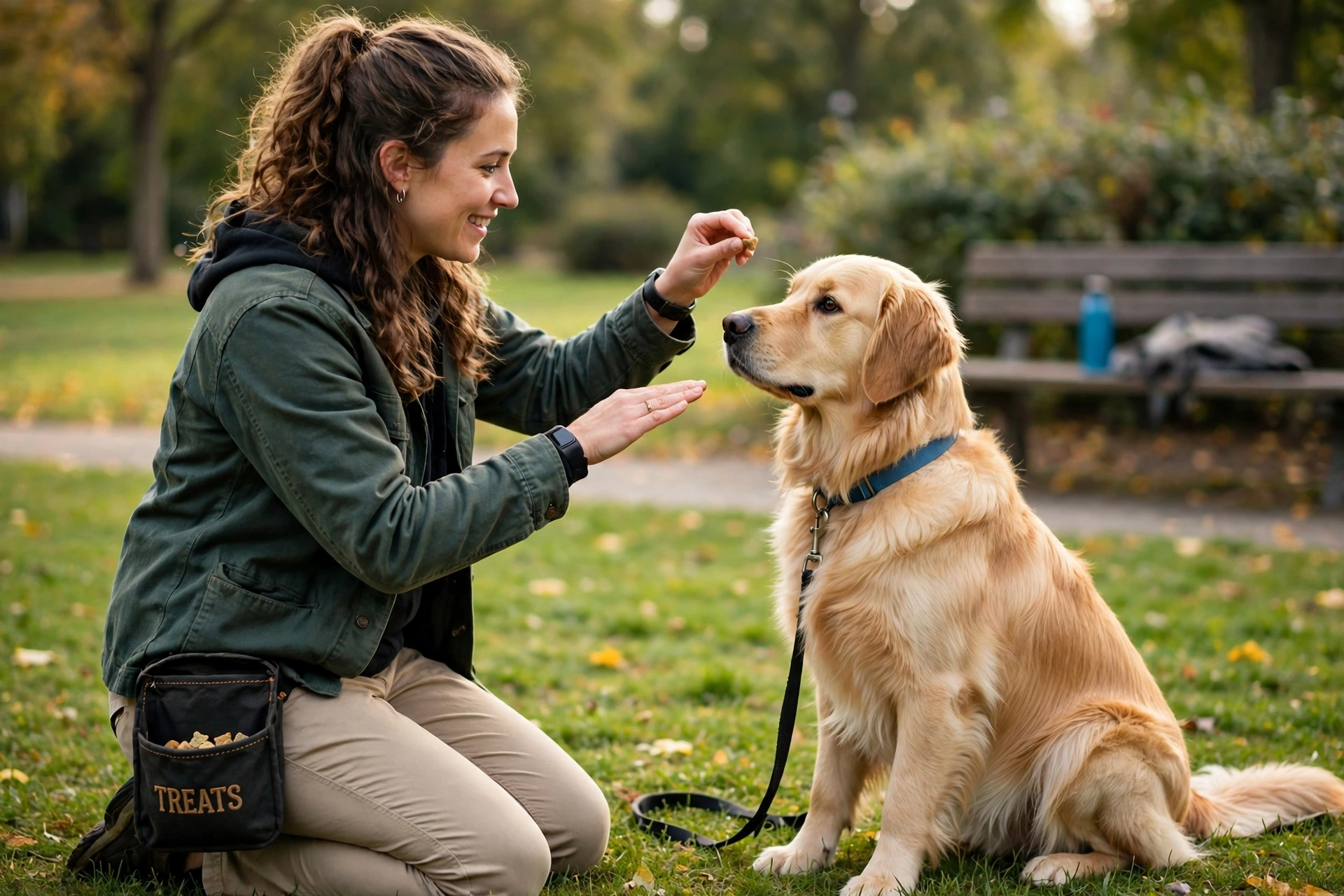
Sit is usually the first command. Hold a treat close to the dog’s nose, then move it slowly up and back over the head. As the nose follows the treat, the bottom naturally goes down. The moment the dog sits, mark it with “yes” and give the treat. After a few repetitions, add the word “sit” just before the movement. Practise in short sessions until the dog sits on the word alone.
Down follows naturally from sit. With the dog sitting, hold a treat at its nose and lower it slowly to the ground, then slide it forward along the floor. As the dog stretches down to follow it, mark and reward. If the dog stands up instead, start again calmly. Add the word “down” once the movement is reliable.
Stay teaches self control. Ask the dog to sit, then hold a flat palm towards it and say “stay”. Wait one second, then mark and reward. Build up slowly: two seconds, then five, then ten, then add a small step back before returning to reward. If the dog moves, go back to a shorter time and try again. Never call a dog from a stay and then punish it for coming, as that teaches the dog that coming is bad.
Come, or recall, is the most important safety command. Start indoors, in a quiet room. Crouch down, open your arms, say the dog’s name and “come” in a happy voice, and reward generously when the dog reaches you. Practise with short distances first, and always make coming to you the best thing in the world: a great treat, a game, praise. Never call a dog to you and then do something it dislikes, such as a bath or a nail trim, as that teaches the dog not to come.
Leave it teaches a dog to ignore something. Hold a treat in a closed fist. When the dog sniffs and then turns away, mark and reward with a different treat from the other hand. Build up until you can place a treat on the floor, cover it with your hand, say “leave it”, and the dog looks away. This command can stop a dog picking up dangerous things on a walk.
House training: a clear routine
House training is about routine, supervision and reward, not punishment. Take a puppy outside often: first thing in the morning, after every meal, after play, after a nap, and last thing at night. Choose one spot in the garden and take the puppy there each time, so the smell reminds it what to do.
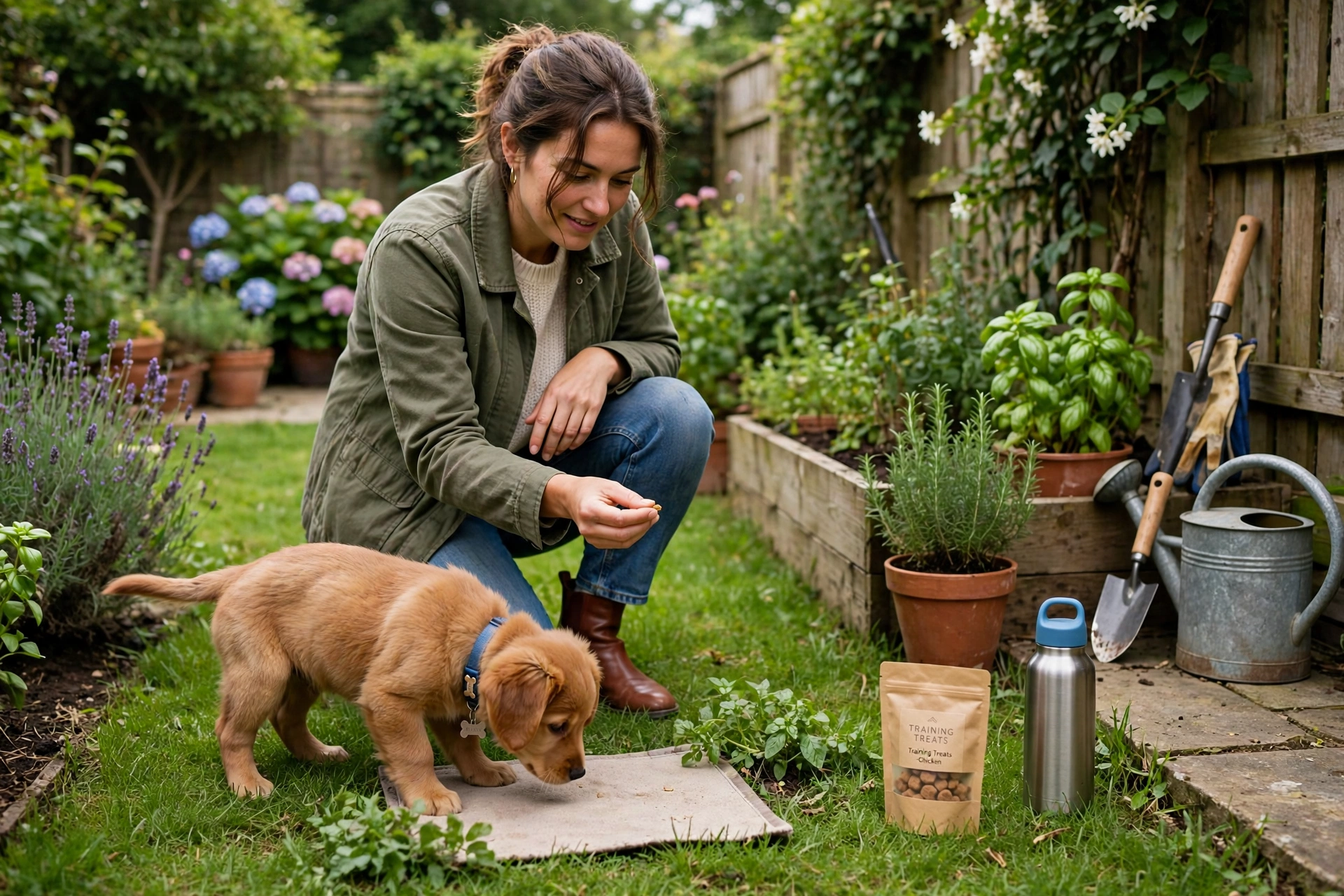
When the puppy goes outside, praise warmly and give a treat straight away. If you catch the puppy starting to go indoors, interrupt gently with a calm word, carry it outside, and reward it if it finishes there. Never punish a puppy for an accident you find later, as the puppy cannot connect the punishment with the act, and it will only learn to hide from you. Clean accidents with an enzymatic cleaner so no smell remains to attract the puppy back to the same spot.
Most puppies need several weeks to be reliable, and some take months. A regular feeding schedule, regular outings and close supervision make it faster. A crate can help, as most dogs avoid soiling their sleeping area, but a crate must never be used as a punishment, and a puppy should never be left in one for long.
Leash walking without pulling
A dog that pulls on the lead makes walks miserable for everyone. The fix is simple, though it takes patience: the dog learns that pulling never gets it where it wants to go, and a loose lead does.
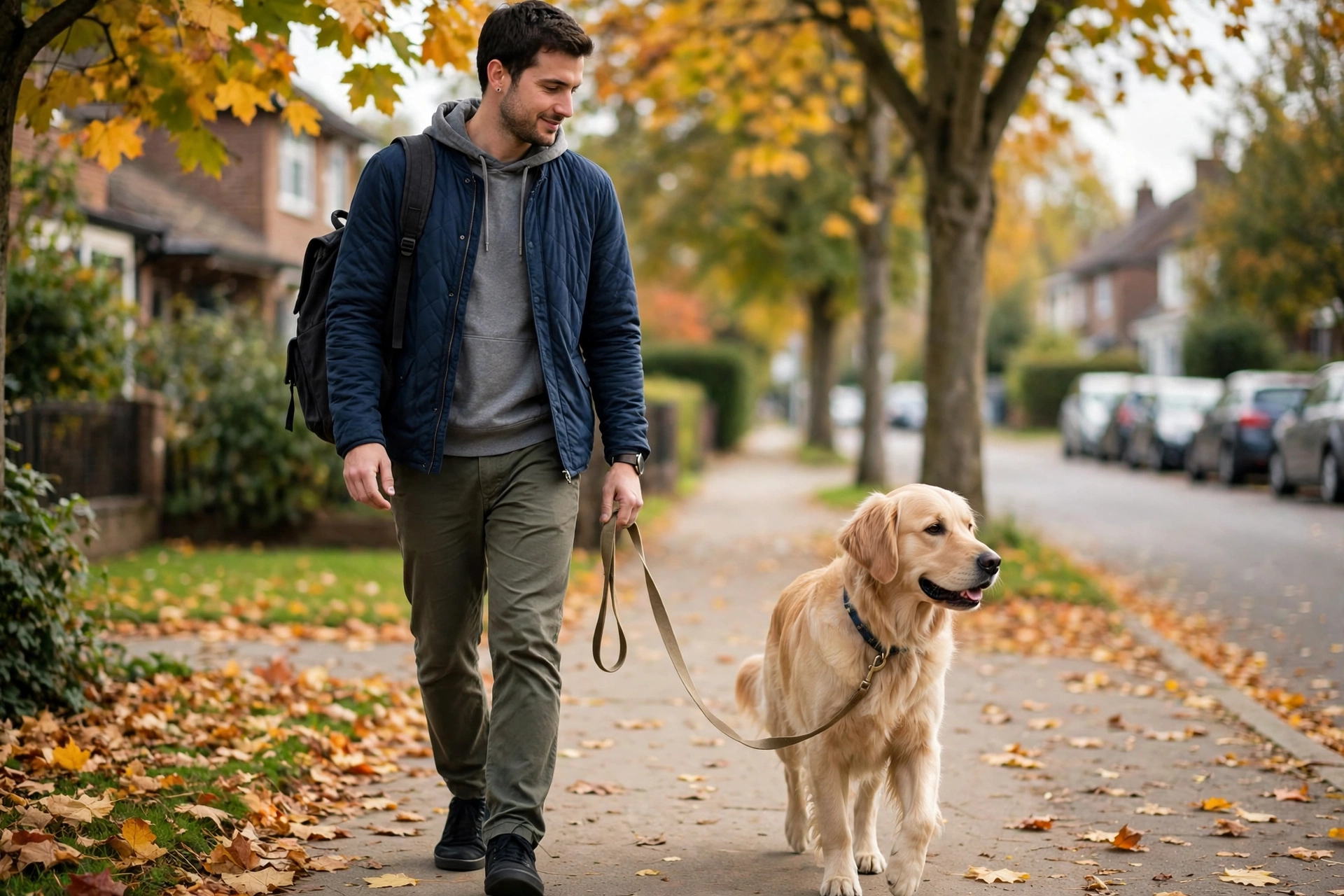
Start in a quiet area. Walk forward, and the moment the lead goes tight, stop. Stand still and wait. When the dog turns back or the lead loosens, even for a second, praise and walk on. Some owners turn and walk the other way when the dog pulls, so the dog learns to watch where the owner goes. Reward the dog often for walking beside you, with a treat or a word of praise, so the correct position is the rewarding one.
Keep early walks short and calm. A tired dog pulls less, so a little play or training before the walk helps. A harness that clips at the front can give more control for strong pullers, and your vet or trainer can advise on the right fit. Never yank the lead, as this can injure the dog’s neck and does not teach it anything.
Donate Now
Socialisation: meeting the world calmly
Socialisation means helping a dog meet new people, dogs, places, sounds and situations in a calm, positive way, especially during puppyhood. A well socialised dog is confident and relaxed, while a dog that missed socialisation may become fearful or reactive.
Introduce new things gradually and always at the dog’s pace. Let the puppy watch the world from a safe distance first, reward calm behaviour, and only move closer when the puppy is relaxed. Meet friendly, calm dogs, not rough or overwhelming ones. Let the puppy hear traffic, see bicycles, meet people of different ages, and visit new places, always with treats and praise for calm behaviour. If the puppy shows fear, do not force it closer; give it space, stay calm, and try again another day from further away.
Socialisation does not stop after puppyhood. Adult dogs also benefit from regular, calm exposure to new situations. A dog that only ever sees the same garden and the same people will find new things harder than a dog that gets out and about.
Common problems and how to fix them
Jumping up is a common problem, and it is usually rewarded by accident: people push the dog down, talk to it, or pet it, which is attention, and attention is a reward. The fix is to turn away and ignore the dog completely when it jumps, and to reward it the moment all four paws are on the floor. Ask visitors to do the same, and be consistent: if jumping sometimes earns attention, the dog will keep trying.
Barking has many causes: boredom, fear, excitement, attention seeking, or warning. The fix depends on the cause. A bored dog needs more exercise, play and mental stimulation. A dog that barks for attention must learn that barking earns nothing, while quiet earns a reward. A fearful dog needs distance from the scary thing and slow, positive introductions. Never shout at a barking dog, as the dog hears more noise and barks more.
Chewing is normal for puppies, especially when teething, and for bored dogs of any age. Give the dog safe things to chew, such as suitable chew toys, and keep shoes, cables and valuables out of reach. If you catch the dog chewing something it should not, swap it calmly for a toy and praise the dog for chewing the toy. Never chase a dog that has taken something, as the chase is a game that rewards the theft.
Separation anxiety is distress when left alone: the dog may bark, destroy things, or soil the house. The fix is slow and gentle: practise very short absences, starting with seconds, and build up gradually, always returning before the dog becomes distressed. Leave a safe chew or a food puzzle, keep departures and arrivals calm and boring, and do not punish the dog for what it did while you were away. Severe cases need a veterinarian or a behaviourist.
Training an older dog
It is never too late to train a dog. Older dogs can learn new commands just as well as puppies, and training is a wonderful way to keep an older dog’s mind active. The same rules apply: short sessions, clear rewards, patience, and one command at a time. An older dog may have habits to unlearn, which takes longer than teaching a puppy from scratch, but consistency wins. Training an older dog also strengthens the bond, and it can help with stiffness and boredom in later years.
Training different breeds and personalities
Every dog is an individual. Some breeds were made to work closely with people and learn quickly, while others are more independent and need more motivation. A food motivated dog is easy to train with treats; a play motivated dog may work better for a ball or a game. A nervous dog needs a quieter approach and more patience, while a confident dog may need clearer boundaries.
Watch what your dog loves and use it as the reward. If your dog loves a particular toy, use it. If it loves sniffing, let a sniff be the reward after a good recall. Training works best when it fits the dog in front of you, not a fixed recipe.
When to get professional help
Most training problems can be solved at home with patience and consistency, but some need a professional. A qualified trainer or behaviourist can help with aggression, severe fear, separation anxiety, or any problem that is getting worse despite your efforts. Look for a trainer who uses positive, reward based methods, and avoid anyone who uses pain, fear or intimidation. Your veterinarian can recommend a good local trainer or behaviourist, and can check whether a health problem is behind a behaviour change.
Keeping training going for life
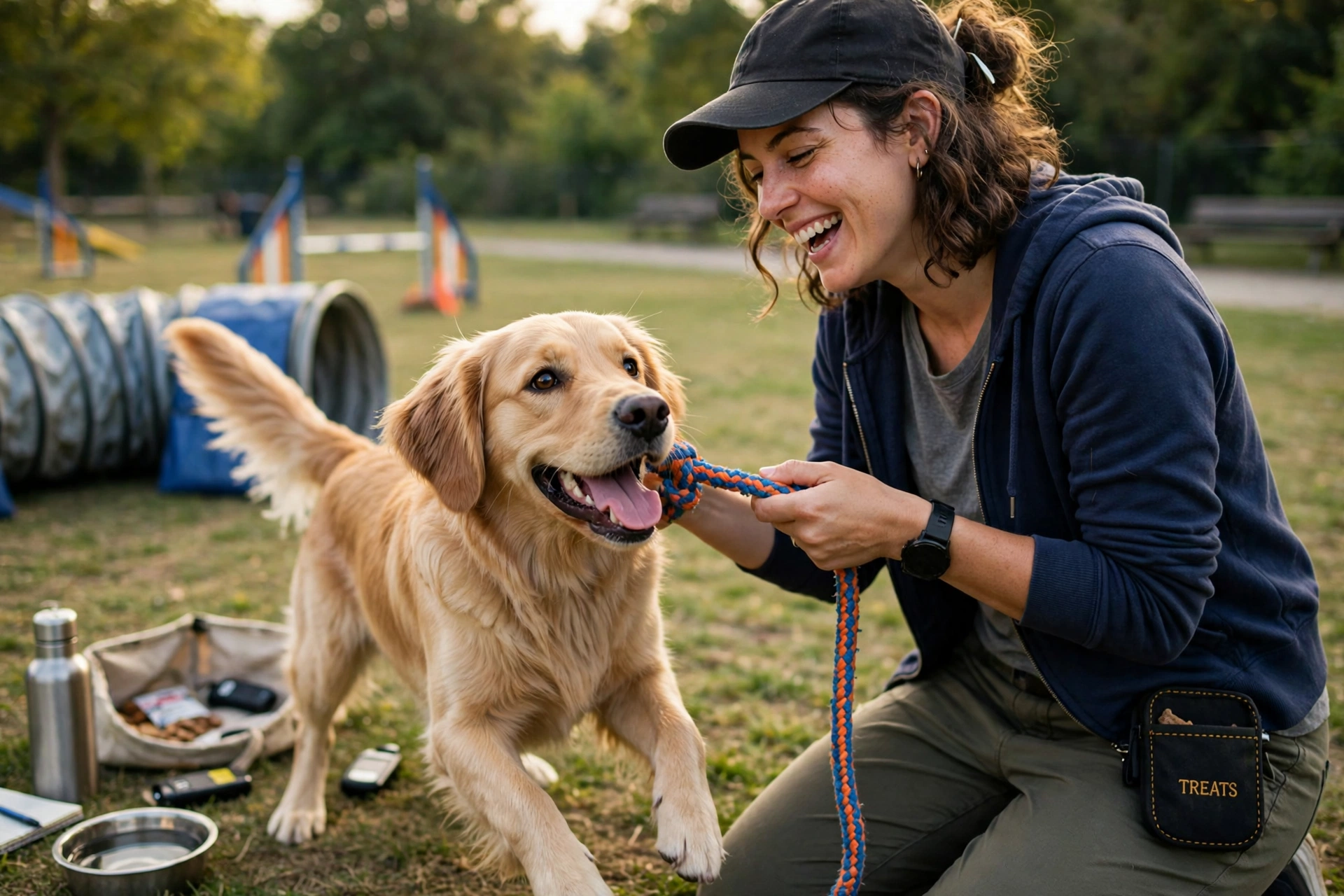
Training is not a one time job. Commands fade if they are never used, so keep practising a little every day, in real life: ask for a sit before meals, a wait before going out the door, a recall in the garden, a loose lead on walks. Short, everyday practice keeps the skills fresh and the bond strong. A trained dog is a happy dog, and a happy dog makes a happy owner.
Donate Now
Conclusion
Training a dog is simple in principle: reward what you want, ignore or gently interrupt what you do not want, keep sessions short, and be consistent. Start with sit, down, stay, come and leave it, build a clear house training routine, teach loose lead walking, and socialise calmly. Fix problems by understanding their cause, not by punishment. With patience and kindness, any dog can learn, and the result is a companion you can take anywhere with confidence.
Donate Now
Help Dogs Get Treatment: Support the Dog Hospital Trust
Not every dog has an owner who can pay for training help or veterinary treatment. The Dog Hospital trust collects donations to pay for veterinary treatment, medicines, vaccinations and care for dogs in need. Your donation, large or small, helps a sick or injured dog get the treatment it deserves.
You can donate through PayPal at vehari566@gmail.com, or by scanning the QR code below to donate through the trust’s TRC20 wallet. Every donation is voluntary, and keeping your payment receipt is a good idea. To learn more about the trust and how donations are used, visit the Donate page on this site. Thank you for helping dogs get treatment.
Donate Now
Frequently asked questions
How long does it take to train a dog?
Basic commands usually take a few weeks of short daily sessions. House training takes several weeks to a few months. Reliable recall and loose lead walking take longer, often months of regular practice.
What is the best age to start training a dog?
Training can start as soon as a puppy arrives home, usually at eight weeks old, with short, gentle sessions. Older dogs can learn just as well, it is never too late to start.
Should I use treats to train my dog?
Yes. Treats are the clearest reward for most dogs. Use small, soft treats and reduce them gradually as the dog learns, replacing them with praise and real life rewards such as a walk or a game.
Why does my dog not listen outside the house?
Distractions are much stronger outside. Practise in quiet places first, then build up to busier places gradually, and use better rewards outside than inside so listening to you is worth it.
When should I get a professional trainer?
Get help for aggression, severe fear, separation anxiety, or any problem that is getting worse. Choose a trainer who uses positive, reward based methods, and ask your veterinarian for a recommendation.
0 Comments